
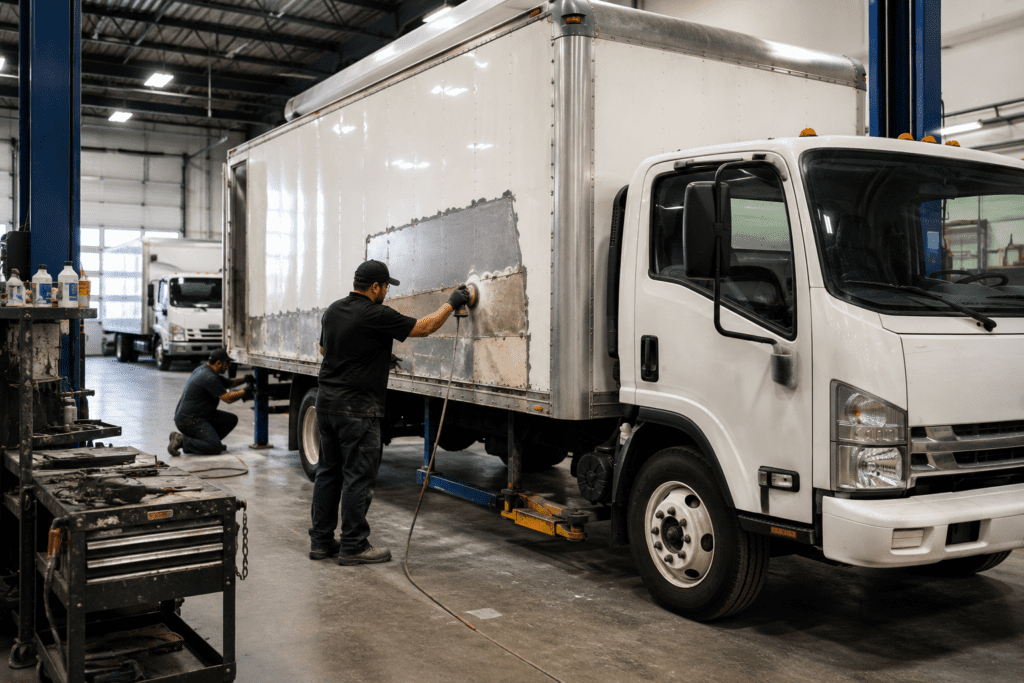

Most operators rank a creased sidewall somewhere below a burned out marker light, and that ranking is wrong far more often than it is right. A box truck’s skin is structure. The panels carry bracing loads and hold the seal along the roof line, which is why a dent that reads as cosmetic in March can be a wet pallet of linens in June. Run five delivery trucks through spring booking season along the Baltimore to Washington corridor and you will meet both versions of that problem in the same month. Estimators doing truck repair Jessup MD fleets rely on watch the same sequence play out every spring, and it always starts with a dock miss nobody bothered to write up. So here is the argument in one line: repairing panels, roof skins and roll-up doors costs less than ignoring them, and dramatically less than replacing the truck.
Dented Panels Read As Neglect To Clients
The first cost of body damage never shows up on an invoice. It arrives when your driver rolls into a venue at three in the afternoon and the coordinator watches the truck park. A dented panel talks before the driver does. Ten years ago that mattered less, because the truck sat behind a service entrance and the only person who saw it was a warehouse manager who had seen far worse. Today the same truck ends up in the background of a venue walkthrough video that gets posted before your crew has finished unloading. The audience changed even though the truck did not.
Rental clients read a beaten up truck as a signal about everything else you own, whether or not that is fair to your maintenance record. That judgment lands before anyone rolls the door up. The panel work you keep postponing gets quietly priced into whether a planner books you again next season.
Skin Damage Opens The Box To Water
Now the part that decides whether the truck stays in service. A creased panel almost never fails by itself. The job we see most often is not the dent at all, it is what the impact did to the rivet line behind it, where a hairline gap pulls moisture in every single time it rains. Aluminum hides that well for a season. Steel does not, and by the second winter of road salt on I-95 the corrosion is running under the paint from the inside out, which is exactly the point where a two hour repair turns into a week in the shop. Once water reaches the floor joists and the rear post, nobody is buying a panel repair any more. They are buying a rebuild.
Water is patient. It does not need a hole, only a seam that no longer closes.
Roll-up doors collect the same abuse from the other direction. Crease a bottom slat on a dock edge and the door still rolls, so nobody writes it up, but the seal now rides a quarter inch high across the curb side. Operators searching for truck repair Jessup MD shops handle every week usually call about a door that sticks, and the estimate ends up being about the water that got in while it was sticking. Call that repair $900 for slats and a fresh seal. Honestly, closer to $1,300 once we pull the track and find the drum bracket bent too.
Panel Repair Now Costs Less Than Replacement
The myth in this one is that body work is a luxury line you defer whenever cash is tight. The arithmetic disagrees. A May 2026 analysis published by Innovative Small Carrier Services put the average annual repair and maintenance cost at $16,192 per commercial truck, with tariff pass-through holding parts prices high and preventive work framed as the most direct cost lever a small carrier still controls. Body damage feeds straight into that number, because an open seam eventually bills as floor, post and liftgate labor instead of paint. Set that against the price of another box truck and the comparison stops being interesting.
Example scenarios from a five-truck event rental fleet, not a published price list.
| What The Operator Assumes | What The Estimate Finds | Example Cost |
| It is only the outer skin | Rivet line pulled, rear corner post out of square | $1,400 to $2,200 |
| The roll-up door still works fine | Bottom slats creased, seal riding high on the curb side | $800 to $1,600 |
| We can touch up the paint ourselves | Mismatched panels across the fleet, visible at trade-in | $600 to $1,100 per panel |
| That truck is too far gone to fix | Panels and roof skin replaceable on the same chassis | $2,600 to $4,000 |
Take one truck out of that five and work it through. It catches a dock post on the passenger side, creasing two panels and pushing the rear corner slightly out of square. Straightening, two replacement panels, a color-matched refinish and new reflective striping lands somewhere in the $2,600 to $3,400 range at current shop rates, and the truck goes back into rotation inside a week. Leave the same truck alone for eighteen months and you are pricing floor joists and a frame section, which is when operators start browsing used replacements instead. A panel job you schedule is always cheaper than the panel job weather schedules for you. The gap between those two paths is rarely marginal.
Fix The Skin Before It Becomes Structure
So walk the fleet once in March with a flashlight, before the calendar fills. Look at seams, rivet lines and the bottom slat of every roll-up door rather than at the dents that annoy you. Anything that has opened a seam goes in now, while a shop can turn it in a day or two and while the damage is still just a panel. Anything purely cosmetic can wait for a slow week in August, and it probably should, because your trucks are earning through the season.
Cosmetic describes a moment, not a diagnosis. The dent you photograph today becomes a seam, and the seam becomes a floor and a rear post that cost several times what the panel would have. Get it estimated while it is still the cheap version of itself, and let the shop tell you which pile it belongs in.