
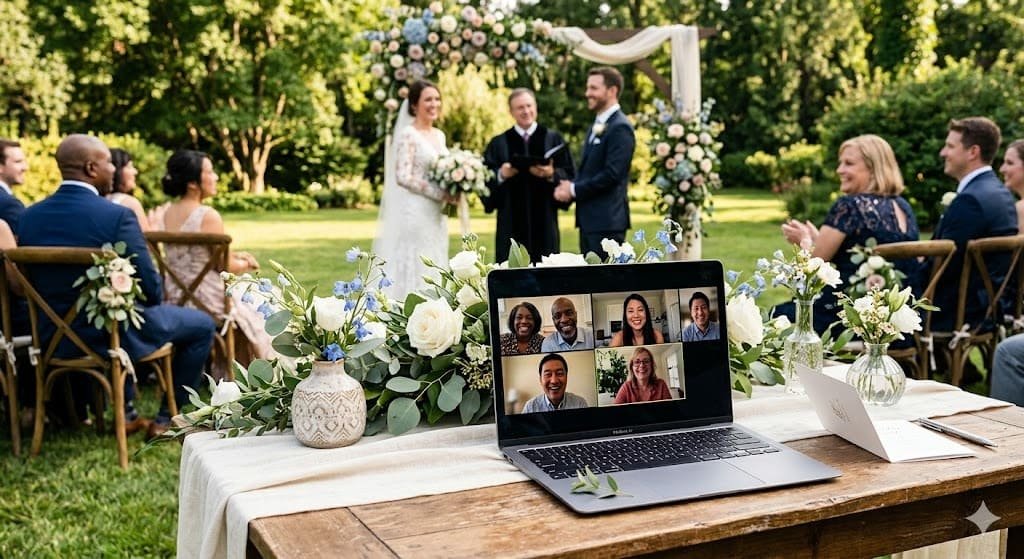

How many people at your wedding will only ever see the ceremony through a screen? For couples on Long Island with family still overseas, the answer is often close to a third of the guest list, and that quietly changes what a search for the best wedding photographer li ny is really shopping for. The day has two audiences. One sits in chairs and can lean around a head to see, and the other watches one fixed frame from eight thousand miles away and gets whatever that frame happens to give them.
Planning for both is a staffing and camera-placement decision long before it is an equipment decision. A studio that already runs photography and film off a single timeline can post a second operator exactly where the stream needs one, while a solo photographer with a full reception ahead cannot, and should not pretend otherwise. That is the argument, and the rest of this is what it looks like on an actual Saturday.
A Phone Propped on a Chair Is Not Coverage
The setup turns up at roughly one wedding in four. Somebody’s cousin props a phone against a folding chair in the front row, angles it at the arch, opens a video call, and forty relatives in Manila watch a slice of the aisle at four in the morning their time. It works until it does not. The battery slides to nine percent somewhere in the readings, an usher crosses the frame, and the phone tips sideways when a flower girl clips the chair leg.
Job after job, the same thing fails first, and it is never the picture. Audio is where a wedding stream goes to die.
A phone twenty feet back picks up an officiant at conversational volume while competing with the string trio, the traffic outside, and whoever is narrating for the relatives at home. Vows delivered at a whisper simply do not arrive. Guests in the seats never notice, because they are close enough and were listening with their own ears anyway. The people watching remotely hear a rustle and a distant murmur, and then they watch everyone else start crying.
One Couple Planned for Two Audiences
A Massapequa couple last spring had ninety guests confirmed and forty more watching from Manila, where the ceremony landed at four in the morning. Their fix was not a better phone. It came out of a venue walkthrough three weeks ahead of the date, and it treated the stream as a second deliverable with its own crew position rather than as a favor someone would handle from the aisle.
The second operator stood at the front, off the officiant’s left shoulder, holding a locked frame on the couple’s faces instead of their backs. On a normal booking that spot is somewhere a second shooter passes through for a handful of frames. Here it was a post for the entire ceremony, which meant the studio sent a third person to cover the reaction angles that second shooter would otherwise be getting. A lapel mic on the groom fed the same recorder the film side was already running, so the stream carried the vows at speaking volume instead of at room volume. (This is the least glamorous line on the invoice and the one couples end up caring about most.)
None of it required exotic gear. It required knowing, weeks in advance, that a body had to stand in a spot nobody would have staffed for photos alone. A photographer booked as a photographer will not think in those terms, and there is no real reason they should. The request has to arrive early enough to land on the crew sheet.
Guest Counts Shrank and Viewing Habits Did Not
Ten years ago, the relative who could not travel got a DVD, or a link to a fifteen-minute edit that showed up six weeks after the fact. Nobody expected to see anything live. The expectation now runs the other direction, and a cousin in another country who cannot watch the ring go on in real time, and type something into the chat while it happens, treats it as a thing that went wrong. Same family, same distance, completely different standard.
Weddings got smaller in the room and larger on the screen at the same time. Fewer flights, fewer hotel blocks, more people attending from a couch two continents away. Long Island families feel this harder than most, because so many of them have a branch that never made the move.
Travel math is what drives it. Destination and multi-venue celebrations run visibly smaller than hometown ones, averaging 92 guests against 123, a gap Carats & Cake put in front of planners in March 2026. The people missing from that difference did not lose interest in the wedding. They are watching from somewhere, on something, and how good that experience is was decided months earlier by whoever built the coverage plan.
Adding a Second Camera Costs Less Than Regret
Say a Long Island package runs $3,800 for a photographer and a cinematographer across the ceremony and reception. A dedicated ceremony operator staffed for four hours rather than the full day might add $600, and a wired feed off the officiant’s mic with a backup recorder is maybe another $180. Call it $4,580 all in. Spread across the ninety people in the room, that is about $51 a head, and counted against all 130 who actually watched it drops to roughly $35. Those figures are illustrative rather than a quote, and pricing across Nassau and Suffolk is wide enough that yours will land somewhere else.
The comparison that matters is not $600 against nothing. It is $600 against the version where the only front-facing camera at the ceremony was a phone on a chair, and the file is now what it is, permanently. There is no reshoot on a wedding. A grandmother in Manila either heard the vows that morning or she did not.
Ask about it on the booking call. Searching for the best wedding photographer li ny and judging on portfolio galleries alone answers half the question, because the galleries show what a studio can capture on a normal day, not how many people it can put in position on a strange one. Studios that already shoot stills and film together tend to answer quickly, since they staff a ceremony that way every weekend anyway. Everyone else will say they will do their best with what they have, which is honest and still the wrong answer for forty people awake at four in the morning.