
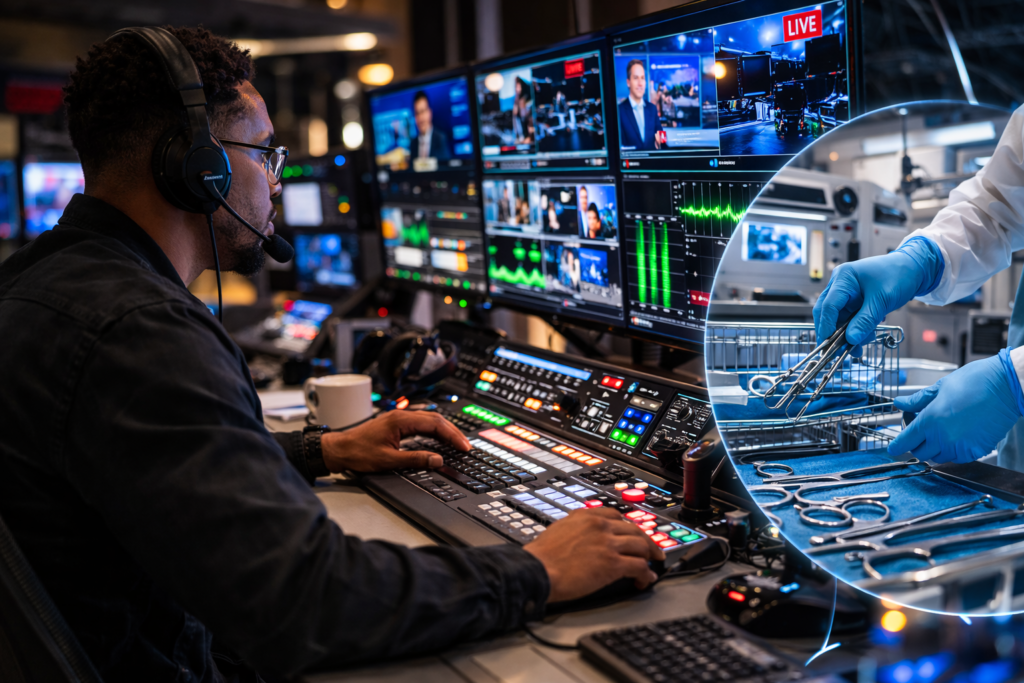

It’s 8:47 p.m. on a Saturday night. Somewhere inside a data center in Las Vegas, a team of broadcast engineers is staring at a wall of monitors. In 13 minutes, 1.4 million people across six continents will press play simultaneously. There is no rehearsal, no second take, and no acceptable margin for error. This is live pay-per-view — and in 2026, the infrastructure holding it together is as tightly controlled as a surgical suite.
That parallel isn’t accidental. The more you study both industries, the more you realize that live broadcasting and sterile processing are governed by the exact same invisible principle: a single point of failure anywhere in the chain is a failure everywhere.
Signal Integrity vs. Sterile Integrity: Two Sides of the Same Coin
In broadcasting, ‘signal integrity’ describes the unbroken, uncorrupted path of a video or audio signal from the source to the viewer. Engineers obsess over it. Every encoder, every router, every CDN handoff is a potential breach point. Redundant systems are not a luxury — they are mandatory architecture.
In healthcare, ‘sterile integrity’ means something equally uncompromising: a surgical instrument has been decontaminated, inspected, packaged, and sterilized according to exacting protocols, and that sterility has been maintained right up to the moment it enters an operating room. A breach anywhere — a torn wrapper, a failed chemical indicator, a skipped biological test — renders the instrument unsafe, full stop.
Neither industry has a ‘pretty good’ setting. You’re either at 100%, or you’re not.
Checklists Are Not Bureaucracy — They Are the Product
One of the most influential ideas to come out of aviation and later into medicine is the checklist. Dr. Atul Gawande’s landmark research demonstrated that simple structured checklists slashed surgical complication rates dramatically — not because surgeons were incompetent, but because human memory under pressure is a known variable, and checklists remove that variable.
Broadcast operations teams figured this out decades ago. Pre-show technical rundowns, signal path audits, encoder pre-flight checks, and failover system verifications are all checklist-driven. A senior broadcast engineer at any major sports network will tell you: the pre-show checklist isn’t something you do before the real work. The checklist is the real work.
Sterile Processing Departments function on the same logic. The ANSI/AAMI standards that govern sterilization — from decontamination water quality to autoclave cycle documentation — are operationalized through precise, repeatable checklists. An SPD technician who skips a step isn’t just cutting a corner; they are introducing an uncontrolled variable into a zero-tolerance system.
The ‘Pre-Flight Check’ Mentality — and Why Preparation Is Everything
Think about live streaming in 2026—a single dropped packet can ruin a million-dollar broadcast. That same high-stakes reliability is vital in healthcare, specifically in the Sterile Processing Department (SPD). Just like a broadcast engineer checks every connection, an SPD technician has to nail every sterilization detail to keep patients safe. If you’re looking to jump into this technical career, you need a solid ‘pre-flight check.’ Using a high-quality SPD practice test is the best way to prep for the CBSPD or HSPA exams. It builds the precision you’ll need for a job where failure simply isn’t an option.
Certification as a System Requirement, Not a Resume Line
Both broadcasting and sterile processing have moved firmly into credentialed territory. Broadcast engineers are expected to hold SMPTE certifications; SPD professionals are expected to earn and maintain CBSPD or HSPA credentials. These aren’t vanity badges — they are evidence that a technician has internalized the standardized knowledge base that makes them a reliable node in a mission-critical network.
The CBSPD certification — offered through the Certification Board for Sterile Processing and Distribution — validates that a technician understands not just the ‘how’ of sterilization but the ‘why.’ That distinction matters enormously when you’re responsible for instruments used in cardiac surgery or orthopedic repair.
The Staffing Reality: Why Technical Operators Are the Invisible Backbone
Here’s what rarely makes the headline reel: every flawless live broadcast and every successful surgery depends on a category of technical operator who almost never appears on a stage or in a press release. The broadcast technician managing the encoder farm at 2 a.m. The SPD tech who starts their shift at 5 a.m. to process the night’s instrument trays before the first procedure.
These roles demand something that can’t be trained out of someone in an afternoon — a professional internalization of zero tolerance. That mindset is built through deliberate training, rigorous certification preparation, and daily exposure to protocols that leave no room for ‘close enough.’
The Takeaway
The broadcast world has long understood that technical excellence isn’t glamorous — it’s structural. The same realization is reshaping how healthcare systems recruit and develop SPD professionals. If you come from a technical operations background and you’re looking for a field that rewards precision, thrives on standardized process, and offers genuine growth, sterile processing isn’t a lateral move. For mission-critical operators, it’s a natural one.
Tags: sterile processing, SPD certification, CBSPD, live broadcasting, technical operations, zero-failure, mission-critical, broadcast engineering