
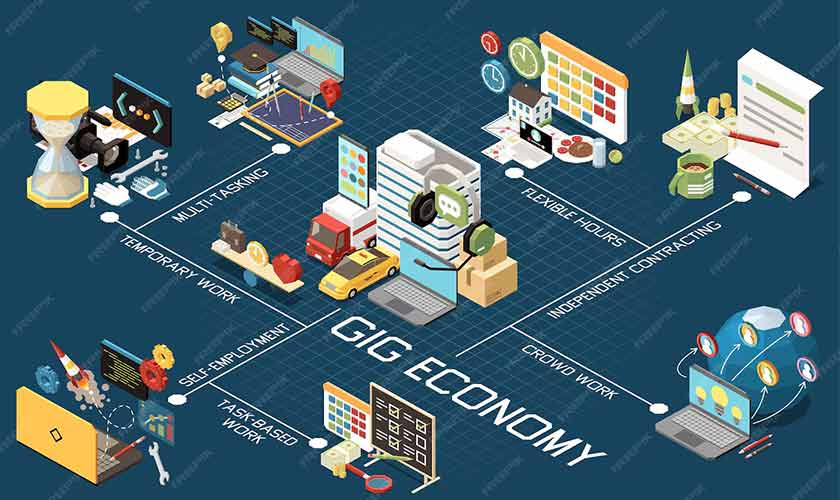

There was a time when getting hired meant sitting across from someone in a formal shirt while they asked you where you see yourself in five years. You smiled, answered carefully, and hoped they like what you said and like you, this model of hiring process still exists
But in the gig economy? It doesn’t really work. When companies are hiring freelancers, contractors, remote specialists, or short-term contributors, they don’t have months to “figure someone out.They don’t even have weeks. The process requires it to be faster and efficient, and that’s where pre-employment testing has quietly become part of the process. This pre-employment testing is not an extra step, it’s not a corporate bureaucracy, it’s a filter.
Why the Gig Economy Changed the Hiring Equation
The reason the traditional hiring process worked for so many years is because companies were looking for employees who are ready to work with them for the coming years. They were assuming stability, which included investment, training resources and retaining them for years.
The gig economy can not promise stability, so the process of hiring them also demands some changes, considering the projects are shorter, contracts are flexible and team forms dissolve quickly.
That means the margin for error is smaller If you hire the wrong freelancer for a two week sprint, you don’t just lose time. You lose momentum and in fast moving environments, momentum is everything. So companies began asking a simple question:
How do we reduce risk before someone starts working?
What Pre-Employment Testing Actually Looks Like Today
Pre employment testing is not always a formal “test” in the traditional sense. Sometimes it’s a small paid assignment, sometimes it’s a timed skills challenge, sometimes it’s a portfolio review combined with a live task.
For developers, it might mean solving a coding problem, for writers, it could be drafting a short piece under a brief, for designers, maybe redesigning a simple interface, for analysts, interpreting a dataset.
The goal isn’t to trick candidates, It’s to see how they think.
Why Companies Rely on It More in Gig Hiring
Resume holds lesser importance in the hiring process of the Gig economy, as the company doesn’t really care about the work experience and long term requirement, they are usually looking at people who understand the skills required and can prove it.
Another reason why resumes matter less, is because freelance profiles can be polished, testimonials can be selective, experience can be vague and pre employment testing brings clarity.
It answers questions like:
- Can this person deliver on time
- Do they understand instructions
- How do they approach ambiguity
- Is their quality consistent
When you’re hiring someone remotely possibly in another country, possibly someone you’ve never met, those answers matter a lot.
The Freelancer’s Side of the Story
Now, here’s where it gets complicated. From a freelancer’s perspective, pre-employment tests can feel exhausting. If every potential client asks for a small sample,and none of them pay for it, you end up working for free.
That’s the dark side of this system, many freelancers have stories about spending hours on test projects that led nowhere. So there’s tension, companies want proof, freelancers want respect.
The balance lies somewhere in between.
When Testing Is Fair (And When It’s Not)
Companies sometimes use this process of pre-employment testing for false use cases, asking the people to do a project and portraying it as a vague test for the job is more common than you think. It’s pretty obvious that evaluating a candidate differs from exploiting one, but how does a freelancer know whether it is evaluation or exploitation?
Fair pre-employment testing consists of a clear scope, limited time, and relevant tasks, transparent evaluation takes place and companies even compensate the employee sometimes.
Unfair testing usually looks like large scale projects shared as a sample with the candidate, with vague instructions and without proper feedback and leads to no closure.
In the gig economy, reputation spreads quickly. Companies that misuse testing lose access to good talent over time. Freelancers talk and communities remember.
Why Skill-Based Validation Is Becoming the Norm
The reason why skill validation is becoming a norm is because the gig economy is built on output, it does not care about office hours, job titles, and hierarchy. So naturally, hiring is shifting towards output-based evaluation.
Instead of asking about the work experience, companies are asking about the current skill set, which is actually a healthier system. It removes some bias, It gives new talent a chance and It rewards skill over credentials.
Someone without a fancy degree can outperform someone with one, if they demonstrate ability and Pre employment testing makes that possible.
The Technology Behind It
Everything behind the Pre-employment testing, every aspect of it deals with technology, with the emergence of the internet, remote took off, which ultimately gave push to pre-employment testing and now with the emergence of artificial intelligence and tools for automation testing candidates has become super easy and super efficient. The process is still the same, you ask the candidate questions and ask them to perform projects related to the work he/she is supposed to know, but technology has made it easy to implement. Tools like online coding environments, automated grading tools, timed assessments, AI assisted plagiarism detection, skill verification platforms.
Companies can now assess candidates at scale, and freelancers can prove competence quickly. In some cases, platforms even assign skill badges based on verified tests.
That creates portable credibility, you dont need to explain yourself every time, your skills are visible.
Does Testing Actually Predict Performance?
That’s the big question and the answer is not perfect, nothing can predict actual performance 100 percent accurately. But practical assessments tend to be better predictors than interviews alone, because interviews measure communication and confidence and test measure execution and in gig work, execution is what clients pay for.
That said, good companies combine both their test skills and then they talk because communication still matters, especially in remote setups.
The Psychological Shift
There’s also something interesting happening at a mindset level. Freelancers who are confident in their skills often prefer being tested. They don’t want long interviews, they don’t want to “sell” themselves endlessly, they rather show their work, that shift reflects something bigger.
The gig economy favors builders over talkers, problem-solvers over presenters and pre-employment testing supports that culture.
Where This Can Go Wrong
If the question is “ Is pre-employment testing perfect?”, then no, nothing is free of issues. If not performed right, things can obviously go wrong with the output, no process or procedure is 100% free of fault. Due to the lack of human understanding, platforms such as testgorilla and testgorilla alternatives, who are hosting the pre-employment testing might favour speed over depth, they might overlook creative approaches and penalize people who don’t have enough knowledge about the hosting platform or format of the test.
Some talented professionals simply don’t perform well in artificial environments, it’s a real thing.. Also, over testing can discourage experienced freelancers who don’t feel the need to prove themselves repeatedly. The smarter companies recognize this and adjust. They scale the depth of testing based on the role and seniority. Not everyone needs the same hurdle.
A Pattern That’s Emerging
What’s becoming clear is this:
A pattern is emerging, is that there is not much space for waste talk, no need for small talk, no ceremony, your only job is to prove your skills as early as you can. This is multiple folds more efficient then the prior ways. It’s more intense but it reflects the pace of modern work.
A Subtle but Important Benefit
There’s another upside people don’t mention often. Pre-employment testing saves freelancers from bad clients too. When a company provides a clear task, structured evaluation, and respectful feedback, it signals professionalism. Freelancers can judge the client just as much as the client judges them. The process becomes mutual evaluation, which is healthy.
So Is Pre-Employment Testing Here to Stay?
Definitely, Pre employment testing is here to stay without a doubt. In this Gig economy, as long as the work remains remote, project based and outcome driven, organizations will always be in need of quick validation, and as long as freelancers want opportunities based strictly on their skills, instead of qualifications and degrees, Pre-employment testing will play its role.
Work needs to be relevant, organizations need to be respectful and the key of this whole procedure is fairness. If done right, companies and freelancers both can hugely benefit from the same. Pre employment testing is a method of knowing that the person is equipped to do the job given and no questions asked, it doesn’t feel like a barrier, it feels like clarity. And in today’s world, clarity can be extremely important to both sides.